Country Guide: Thailand
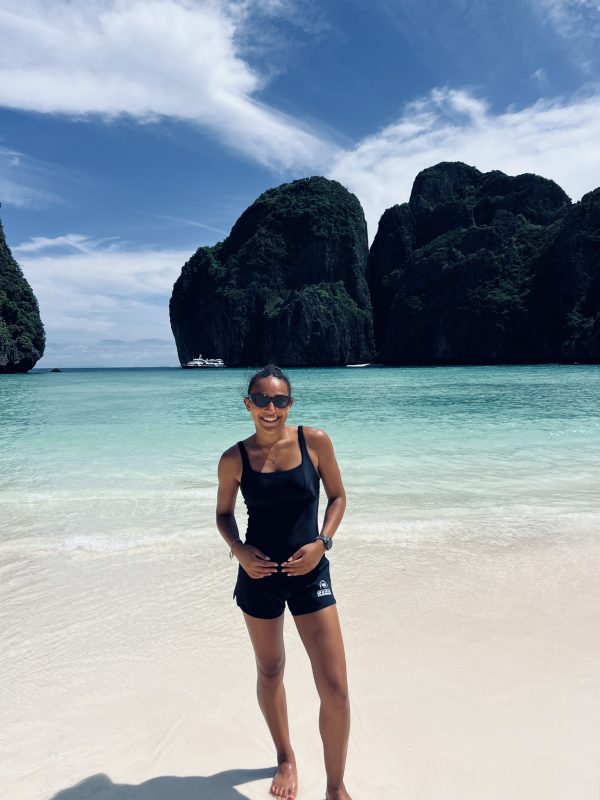
By Tanda Adamou, who studied abroad on the Faculty led program – Community and Sustainable Practices in Global Tourism in Summer 2026.

Why did you choose the location you studied abroad in?
My decision to go to Thailand was rather impromptu. I had to change my plans last minute as my first choice, a trip to Ghana, was canceled. When given the list of open programs, Thailand was one of the only ones that wasn’t taking place in Europe. My education and life experiences have largely been shaped by western ideologies and influences. Thailand was novel in that I hadn’t explored that part of the world, nor was I familiar with Thai customs and traditions. Beyond finding the program’s course material interesting, I was drawn to Thailand because it promised (and delivered) adventure.
Describe the city you studied in.
(Include information regarding the weather, architecture, size of the city, feel of the city, etc.)

Food
(Describe the types of food that are common in the host city or country. What were the types of foods you could find at most restaurants? What were some delicacies of that city? What were your favorite or least favorite foods? Are there any particular restaurants you would recommend students try if they are in that city?)
Chiang Mai is known for a chicken curry dish called khao soi. It’s a staple of Thai cuisine and can be found on nearly every Thai restaurant menu. This was my go-to when I craved something predictably delicious Some classic, familiar dishes included pad thai and pad see ew (great for people with peanut allergies). Another popular delicacy is mango sticky rice. I wasn’t as big of this dessert, but when made fresh with ripe mango, it’s very tasty. Thailand has a strong street-food culture and while a lot of the stands look tempting, I learned that it’s important to use discretion when selecting where to eat. Raw meats that are left to sit and fruits without their peels should generally be avoided, but foods that are cooked in front of the customers are safe. The program organized a welcome and farewell dinner for each location which included a full course menu of authentic Thai food at an upscale restaurant. Each restaurant was very accommodating of food limitations, but I recommend finding the translation for specific allergies and writing it down ahead of time to be safe.
A vegan friend of mine found a meatless restaurant in Phuket called The Vegan Table. Since it’s located in Old City, it was a great opportunity to try new foods and explore a new part of the area.
Language
(What are the language(s) or dialects? How did you cope with the language barrier or accents (in English-speaking countries)?)
The main language in Thailand is Thai, but this is country whose primary revenue streams come from tourism. Street signs, advertisements, and menus were all available in English. I had very little difficulty cashiers, waiters, hotel workers, and store clerks as they either spoke English or had a translator app. The only time communication was challenging was when visiting rural mountain villages where residents were elderly and spoke predominantly Thai. Even then, patience and a lot of hand gestures on behalf of both parties is enough to facilitate a basic exchange. I learned a few Thai phrases and greeting customs prior to arriving which proved to be very useful. In addition to using a different greeting depending on the gender of the person who’s being addressed, Thai people have a bow that corresponds to the person’s authority level. Executing this greeting and bow correctly is a good show of respect.
Differences in Culture
(Describe some of the differences between U.S. culture and the host country culture. What are some aspects of the host culture that you struggled with and some that you appreciated? How did you adapt to the new way of life?)
Thai culture is very laid-back. The people are friendly and willing to help if that same kind is reciprocated. There’s a strong reverence for the royal family, so I had to be hyper aware of not saying anything about the monarchy that could be perceived as offensive. Speaking ill of the royal family publicly is a punishable crime. Because the king and queens’ faces are printed on the currency, it was crucial that I learned to handle money correctly. Crumpling or stepping on baht was a big taboo. Heads are considered sacred and feet are considered dirty, so I had to avoid propping my feet up or point them towards a Buddha statue. In the U.S., it’s very common for waiters to ask whether the customers want their checks together or separate. In Thailand, the general assumption was that my peers and I were paying together, so we had to communicate to waiters ahead of time if we were paying separately. When visiting temples, I had to cover my knees, shoulders, and stomach to show respect.
Locals
(How would you describe the locals in the host city? Where and how did you befriend the locals during your stay?)
Locals were very friendly and easy to talk to. I befriended students at Payap University during a day tip after which we exchanged contact information and kept in touch! There are certain pop culture references and icons that are trans-continental and can serve as a universal topic of conversation. I found I had a lot more in common with young people living across the world from me than I initially thought. Thailand is melting pot, especially in high season for tourists. I met a couple from Sydney at a mall in Bangkok, a group of Japanese high school students and a guy from the Netherlands in Chiang Mai, and a marine biologist from Russia in Phuket.
Events, Festivals & Holidays
(Are there any cultural events that you attended during your stay that you would recommend to students (e.g. festivals, holidays, etc.?) How did you find out about these events? If you had a fall break or spring break, how did you spend your time?)
My time in Bangkok overlapped with the first day of Pride. There was a gigantic parade with rainbow glitter, several drag queens, and massive floats. There was music playing everywhere and an unbelievably large crowd of people who came out to support. I highly recommend anyone who travels to Thailand in June take part in this beautiful display of love. Halfway through the trip was the queen’s birthday. As this is considered a national holiday, most businesses were closed and we didn’t hold class. Because most people were off work to celebrate, this was a great time to walk around the city midday as it was less crowded.
Culture Shock
(Describe any culture shock that you experienced while abroad as well as some ways you coped with it?)
In America, there’s a big movement against the unethical treatment of animals. While this same movement exists in Thailand and there are laws against exotic animal trafficking, policies meant to prevent exotic animal vendors from openly selling their animals aren’t as strictly enforced. I came across a market selling racoons, meerkats, squirrels, and monkeys which is something I’d never seen in the states. As an animal lover, I found this particularly shocking as the market itself was huge, and the animals weren’t in the best condition. I eventually had to remove myself from the situation as openly judging wasn’t productive nor would it take into account that laws vary by country.

What type of housing did you live in?
(e.g. homestay, dorm, apartment, etc.?Why did you choose this style of housing? What type of amenities did you have access to (kitchen, bathroom, etc.). Did you have roommates (if so, describe where they were from).)
In Chiang Mai I stayed in a boutique hotel called Baan Thai Village. In Bangkok I stayed in an Ibis, and in Phuket I stayed in a hotel that specialized in sustainability, The Peach Blossom Resort. I shared a room with a roommate that remained the same the entire time. All the accommodations had complimentary breakfast, but I had to outsource the rest of my meals. Since this program was faculty-led, hotels were booked and chosen for me. There was only accommodation that varied immensely from the rest of the hotel experiences. I spent four nights at Pun Pun Organic Farm, where I shared a floor with my female classmates. We each slept on a mattress on the ground with a mosquito net. Bathrooms were located outside of the dorm as there was no in-house plumbing. It was a formatted like a commune, so meals were eaten in a shared dining space, and meal prep was a shared task. All the architecture was open concept and constructed with earthen materials (which I helped put together). This was great for natural air conditioning, but it meant I had to be careful about leaving my stuff out as it would get drenched when it rained (there were no window panes and the roof wasn’t sealed).
Where was your housing located?
(Where was your housing located in regard to the city center or host university? How long did it take, using public transportation or walking, to get to classes and the city center every day?)
My hotels were always central to the city I was visiting. The program organizers structured our accommodations so that the distance to each day trip location was either walkable or accessible via a relatively short bus ride. As this was a faculty-led program there was no host university where I had to attend classes every day. My professor considered Thailand and the day-to-day activities the classroom. Transportation was arranged for us daily so as long as I was on time to meeting point, I never had to arrange my own.

Academic Environment
(Describe the interactions you had with your professors, the way the classes were administered (e.g. lecture, participation, etc.). What were some of your favorite classes? What are some differences in the academic environment compared to UNC Charlotte?)
Thailand only lasted three weeks, so staying on schedule with course content and deadlines was imperative. My professor would hold either an open discussion or a debrief to digest new information and introduce concepts. There were textbook readings each week that corresponded to the the sustainability or community development topic we’d be covering, but most of the learning was experiential. I learned more from networking with nonprofit organizers and local nonprofits than I did from the readings, and that’s what the program organizers intended. This was unlike any class I had taken before as it wasn’t confined to a predictable weekly time slot. The learning was constant, and I had to manage my time diligently. This program was academically demanding but just like at UNC Charlotte my professors were very receptive and willing to help whenever I needed to consult.
What was the cost of living abroad?
(Compare costs of everyday items to the costs in Charlotte. How did you stick to your budget? Were there any student
discounts you took advantage of?)
What I spent in a week in Thailand I may spend in three days in Charlotte. The cost of living and how inexpensive it is was one the biggest shocks, and perhaps the most positive one. There were no student discounts that I was aware of, but I cut costs whenever possible. Any service done through the hotel is automatically more expensive, so I tried to shop local. On average I spent about 3,000 baht per week ($86 USD). This includes shopping for souvenirs and clothing. The weekly total spent solely on necessities was a lot cheaper. Prices varied by location with Bangkok being the priciest and Phuket being the most affordable. I stuck to my budget by only converting a certain amount of cash per week and avoiding credit card use. Had I withdrawn more than I needed at a certain time, I would feel obligated to spend it.
Communication
(How did you communicate when you were abroad? (e.g. did you use your phone only on wifi, did you purchase an international plan, purchase a phone abroad, etc.) Would you recommend any helpful apps?)
There was wifi at each of the accommodations we stayed at. The only exception to this was Pun Pun, but the professors didn’t assign any work during this time as they knew this would be the case. I got the Verizon Wireless International Plan which afforded me the same faculties as my domestic plan. The only thing I couldn’t do without getting charged was place a phone call. My computer wasn’t included on this plan and didn’t connect to a hot spot, so I relied solely on wifi. WhatsApp was crucial as this is how I contacted my family and program faculty. If there’s available wifi, it works anywhere. I didn’t stop using WhatsApp until my flight landed in the U.S. again.
Packing
(What would you recommend students definitely take with them when packing before departure? What would you recommend they leave behind?)
Pack light and when in doubt, leave items behind. With the amount of traveling we did, both air travel and ground transportation, it was imperative that I didn’t have a lot of luggage. Packing light enabled me to travel with my bag as a carry on which eliminated a lot of stress going there. Seeing as this was a program about sustainability and tourism, my professor graded me on the number of bags I brought. I was able to comfortably fit everything I needed into a single backpack. Even then, I realized I packed slightly too much. The small necessities (sunscreen, bug spray, toothpaste) can be bought on site if they’re not already packed. Students need an adapter for their charger, a notebook, and a small belt bag or backpack that can easily fit inside their larger backpack for carrying belongings during day trips.

Why did you decide to study abroad?
I studied abroad because I wanted to get outside of my comfort zone. A professor once shared that once students study abroad, the come back with a newfound sense of confidence and self-assuredness. As a freshman, I had spent my entire schoolyear gradually building my independence and growing in my ability to take control of my academic career. Studying abroad felt like the perfect opportunity to test these skills—adaptability, networking, critical thinking—in a setting that was entirely unfamiliar.
What part of your experience made the greatest impact on you?
Studying abroad taught me that I’m more capable than I initially thought. Not only did I manage multiple international flights and airports, but I stayed on top of coursework, built new connections, and conducted research, all while remaining engaged. Traveling to a new country seemed daunting given the fact I didn’t speak the language, nor was I familiar with that part of the world; however, I proved to myself that I can withstand these challenges. As part of my self-development, Thailand exposed the blind spots in my world view. People often harbor a stigma towards countries and cultures that don’t mirror their own. During my time abroad, I realized I had these unbased preconceived notions that I had formulated without even visiting Thailand. I now know to keep in open-mind and be receptive to perspective or concepts that I may not be surrounded with.
In your opinion, why should students study abroad?
Studying abroad unlocks a level of self-discovery that some take a lifetime to achieve. I underestimated the profound impact just three weeks would have on my life, yet Thailand has shaped the trajectory of both my personal and academic career. Upon returning, I’ve since considered completing graduate school outside of the U.S. because of the conversations I had while abroad. Going into my second year, I feel exponentially more confident as studying internationally has taught me that I can handle change. Where I once backed down from new obstacles or challenges, I now rise to face them. This is the ultimate leg-up, not only in school and careers but in life.