Why Study Russian in the Baltics?
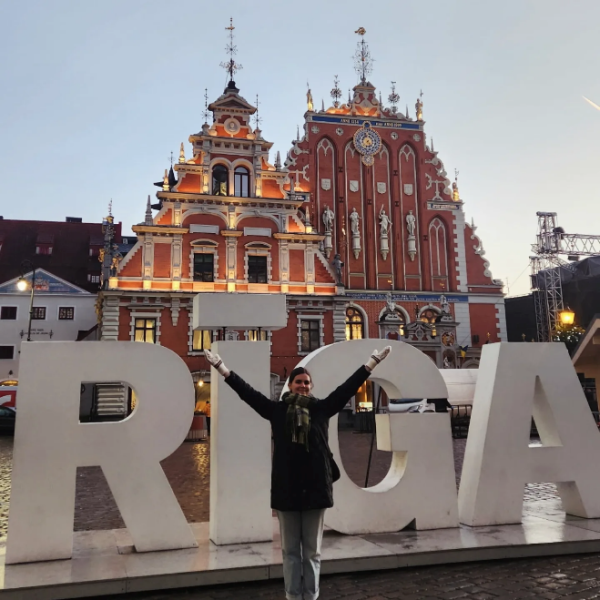
By Hannah Rowles, who studied abroad on the Learn Russian in the European Union – “Russian language and East European studies” program in Fall 2025.
When I first began looking through potential study abroad programs, I had already been studying Russian for around three years. I knew that I wanted to continue studying this beautiful language abroad, but I didn’t necessarily want to go to Russia itself. Through my search for abroad programs, I learned that there were (and are) actually quite a few options for students like me. The Russian language is widespread across many former Soviet countries, meaning that students can use and improve their language skills while experiencing many different countries and cultures. Studying Russian in the Baltic Sea region, particularly in Latvia or Estonia, is one such opportunity.
Both Latvia and Estonia have significant Russian-speaking minorities that make up around 25% of each country’s population. These minorities include not only ethnic Russians, but also Belarusians, Ukrainians, Poles, and others who use Russian as a lingua franca. While Russian is not an official language in either Latvia or Estonia, there are regions in both countries where Russian-speakers are in the overwhelming majority
and the national (Estonian or Latvian) language is rarely encountered on the street. The Latvian city of Daugavpils, where I lived and studied for the duration of my semester abroad, is one such place.
Daugavpils is Latvia’s second largest city, after its capital of Riga, and known as the most Russian-speaking city in the European Union. This is by no means an exaggeration. Almost 50% of the city’s population is ethnically Russian, and another significant portion are Russian-speakers from other areas of the former Soviet Union. Over 90% of the population uses Russian as the language of everyday communication.
While I was aware of these numbers before going abroad, the extent to which Daugavpils is linguistically unique didn’t really sink in until after I arrived. I can count on one hand the number of times I heard people actually conversing in Latvian, and if it weren’t for the signage around the city (signs are legally required to be written in Latvian) I might have been able to convince myself I was across the border in Russia. It really is the perfect place to host a Russian language immersion program. Outside of almost exclusively Russian-speaking pockets like Daugavpils, the Latvian and Estonian capital cities of Riga and Tallinn (respectively) are also places where the Russian language is prevalent. When I visited these cities during my semester abroad, I often heard Russian spoken on the street, particularly in certain
areas of the city. For example, Riga Central Market, a massive market located in what used to be a zeppelin hangar and offering food, souvenirs, and other goods, is one place where Russian is used a lot (at least in my experience). As the capital cities of Latvia and Estonia, Riga and Tallinn are both very tourist-friendly, meaning English is also used extensively in many areas.
Whether you’d prefer the quiet charm of a place like Daugavpils or the colorful bustle of a larger city such as Riga or Tallinn, studying in Latvia or Estonia offers a great opportunity to improve your language skills while immersing yourself in the vibrant
culture of these countries.
Language Immersion and Study Abroad
As a student and aspiring polyglot, I can easily say that language immersion is one of my all-time favorite things. I’ve participated in multiple language immersion programs over the course of the past few years, and I will always highly recommend immersion to anyone looking for a deeper understanding of their target language. So, what is language immersion? Language immersion is when a student immerses themselves in their target language as fully as possible. This can be as simple as reading a book, listening to music, or watching a film in your target language. It could also mean participating in a more organized and intense language immersion program.
Language immersion programs are designed to immerse the student in their target language to the fullest extent possible by creating an environment in which the student has to use the target language all day, every day, for the duration of the program (excepting emergencies, of course). Coupled with intensive classroom instruction in the target language, this helps students to rapidly increase their language proficiency over the course of only a few weeks or months. There are a lot of highly rated language immersion programs based at various universities in the US, so you don’t necessarily have to study abroad in order to participate in a language immersion program. However, having done both domestic and international language immersion, I’ve noticed some distinct language-learning benefits to studying abroad in a country where the target language is natively spoken.
Firstly, studying abroad allowed me to gain a much better “feel” for my target language than I would have ever been able to obtain by studying in the US alone. The way native speakers use a language is vastly different to how that same language is spoken by students in a classroom, or even at a domestically based immersion program. These differences aren’t limited to the greater prevalence of slang terms and idioms, either. Even the speech patterns and sentence structure of native speakers can be a bit different from the textbook version of the target language. Both variations may be grammatically correct, but a native speaker might tend to use one word/phrase/structure more often. Since, while studying abroad, I was constantly interacting with native speakers of my target language, I began to pick up these differences naturally in context. Now, I am able to produce smoother, more organic, and more native-like speech in my target language.
The second major benefit of studying abroad to enhance your language skills is that it allows for greater exposure to the culture(s) associated with your target language. Language and culture are closely linked, and it is impossible to fully understand one without at least some understanding of the other. How we think about and view the world has a significant impact on how we use language, and I found that my semester abroad really brought this relationship into focus. Exposing myself fully to the culture of my host city opened up an entirely new depth of understanding of my target language and offered me a glimpse into the lives of those who speak it natively. This was undoubtedly one of the most valuable things I came away with from my study abroad experience.
If you are currently studying a foreign language, or are interested in studying one, I highly recommend considering language immersion and study abroad as ways to increase your language proficiency and cultural understanding!