Country Guide: Scotland
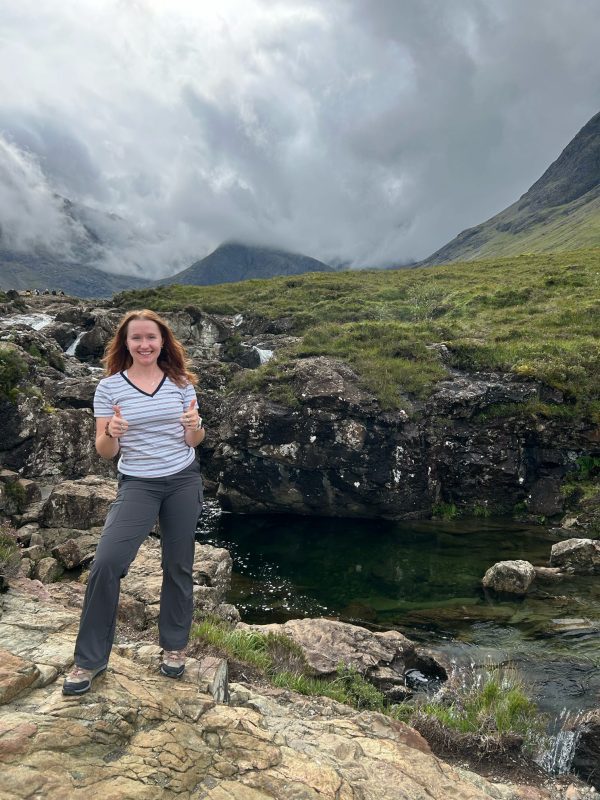
By Rachel Trivette, who studied abroad on the International Summer School: University of Stirling program in Summer 2025.

Why did you choose the location you studied abroad in?
I chose the location I studied abroad in because the city of Stirling is a bit smaller than Glasgow or Edinburgh but still has rich historical significance and a friendly and inviting culture! Stirling has historical landmarks such as Wallace Monument-home to the sword of William Wallace, the Church of The Holy Rude which predates Mary Queen of Scots, and Greyfriars Kirkyard which is one of the top three oldest graveyards in Scotland. Stirling is also a very walkable, safe, and explorable city that welcomes college students and tourists. Stirling seemed like an exciting, yet safe city to stay in.
Describe the city you studied in.
The city of Stirling feels historically old. The streets are all brick or cobblestone, and the shops all have residential apartments above them. If you go down one road, you will find a state-of-the-art shopping mall with name brand stores, and if you go down another road you will find the Church of the Holy Rude which predates Mary Queen of Scots. Everyone you meet is excited to share their city with you. The weather was very pleasant! Rainy days were rare, which according to locals was extremely rare.
Day-to-day Transportation
Transportation was very convenient. There was a bus that would transport students from the university to the city of Stirling and there was an app that would allow you to buy student passes for little more than an American dollar a day. There was a train station directly across from the Stirling city bus stop that also sold student tickets, so getting to bigger areas or the airport was a breeze! On campus or in any city, walking is easy and effective. There were taxis in Stirling, and Uber and Lyft in larger cities like Glasgow and Edinburgh.
Personal Travel
I traveled throughout Scotland to different cities, and I travelled to Norway with some friends I made. Traveling throughout Scotland was fairly easy thanks to the trains. I was able to go on a driving tour of the Isle of Sky which was an organization that partnered with the University of Stirling for college students to experience. Generally, travelling through the cities of Scotland was very affordable. I never spent more than 15 American dollars on train tickets and the train ticketing app was helpful for finding good deals.
We decided to go to Norway because none of us had been before and the flights and Airbnb were very affordable. One person in our group booked the flights and accommodation. Once there we took the public bus from our Airbnb to the city of Oslo. The transportation and accommodation were affordable, but the food was expensive.

Food
“Pub food” is very popular and very yummy. Pub food is fish and chips, and other fried foods. There was also a wide arrange of Indian cuisine that was always very delicious and affordable! My friends and I loved going to Witherspoon’s which is a chain restaurant in Scotland. They had the best food and the BEST sticky toffee pudding that always came out hot and smelled amazing. They also had special deals for college students on certain nights.
Language
Stirling, Scotland is a predominantly English-speaking city. The only difficulty I had was the accents, but people were always very kind and understanding if you asked them to repeat themselves. As long as you are kind and respectful (do not mock them) they will do their best to help you. Some people did speak Scottish Gaelic, but they also spoke English. We did run into many tourists that did not speak English, but they were still friendly and respectful.
Differences in Culture
The thing that shocked me was that no one on campus carried pepper-spray or even cared to. It felt so safe. After the first week it was not uncommon to find us international students walking around the Loch with our new Scottish friends at 10 pm or 11pm at night. One night I had a difficult time sleeping and at 3am decided to walk the loch. I felt completely safe and even met a few kind elderly people who were walking their dogs. Granted, the sun was coming up at 3:30am so it was not dark, but I greatly appreciated and miss that aspect.
Locals
The locals were incredible! They were all so kind and excited to talk to you about anything and everything. I met many of the locals I befriended at Witherspoon’s or at pubs where I had lunch regularly. The locals were really good at remembering faces so if you met them once you rarely had to reintroduce yourself. I also met some very nice locals at the Church of the Holy Rude. My friend and I attended Church services there and on the first week were invited to lunch by a few locals.
Events, Festivals & Holidays
I did not attend any festivals or holidays, but if you are able to attend any Highland games I have heard they are awesome and I am sad I missed them. Many towns will advertise their own highland games, and the city of Stirling is one of them. You will see flyers all around the town, and many locals will ask if you plan to go (if you are there close to when the games are).
Culture Shock
I think the biggest culture shock was the no pepper-spray and the feeling of “chill” on campus. It only took about a week to get used to it, but it is still something that I think about often. I also experienced culture shock the first time I went to get groceries. I went all by myself, hopped on the bus to town, got off and went into Tesco to get my groceries, hopped back on the bus and went back. While that may not sound crazy, it was my first week in a new country, I knew no one, and it was just expected of us to be able to go to the store and transport our way there and back. They did show us how to get there and which bus to take, but I did all of that on my own and that was the cultural norm.
By the end of the trip, one of the things I missed most was my car. I really missed being able to just drive directly where I wanted to go.

What type of housing did you live in?
I lived in a shared flat that was used for University students. This was the type of housing that was offered through the program and mine I shared with four other flatmates. We all had our own rooms, full baths, and shared a kitchen and living space. Laundry machines were shared by the whole building. My roommates were random, but they did have us take a survey that asked us what type of roommate we were and then what type of roommate we would prefer to have to match us all accordingly.
Where was your housing located?
My housing was on campus just a 4-minute walk from the student union. Walking to classes was very simple and the walk was gorgeous. You walk outside of the accommodation, and there is a bridge that goes from your side of the Loch to the student union and from there it’s just a walk down the hall to class. To get to the bus stop it may have taken about 7-10 minutes depending on which route you walked. If you wanted to walk to Stirling, it may have been a 25- minute walk.

Academic Environment
My classes were lecture style, and my professors were all extremely kind and engaging. I honestly enjoyed all of the classes I took and would take them all again. The grading system was a little different, but they explained all of that to us the first day. We got to go on a lot of field trips which was incredible. The faculty and staff were really focused on us experiencing Scotland first hand rather than in the classroom.
What was the cost of living abroad?
The cost of living was very similar; it all came down to your choices really. I wanted to save money as much as I could, so I would grocery shop at Tesco and meal prep, allowing the weekends and field trips to be times where I ate out. Restaurants were a bit pricey, but many would have a lunch menu that would have discounted prices. Eating out in Edinburgh or Glasgow was very expensive, but there are certain places that are more affordable and again, lunch specials are helpful. Student discounts for bus passes and train tickets were very helpful as well.
Communication
The host university provided SIM cards for us students so we could communicate with them and our family and friends. We did have to pay for whichever service plan fit our needs best, but there was also free university Wi-Fi. Many students, myself included, used WhatsApp to communicate with classmates and our people in the States. Some people were able to use regular text, but just as a backup I would recommend WhatsApp. It was very reliable and worked with or without Wi-Fi as long as you had signal.
Packing
The University provides clean bedding, pillowcases, duvet covers, and towels weekly. I would absolutely say pack layers, a raincoat is a must, big spray, and shoes you do not mind walking miles uphill in. I brought old sneakers that I knew I would be comfortable in but did not mind messing up, and at the end of my stay I just threw them out to make more room in my suitcase. Anything you do not want to take back with you, you can donate to the on campus donation store or to any of the charity shops in Stirling. I would say to make sure you leave room for any souvenirs for sure.

Why did you decide to study abroad?
I decided to study abroad because I intentionally wanted this to be an experience that was solely my own- one that would push me out of my comfort zone and encourage personal growth. I fell in love with Scotland years ago on a family trip and when I saw the opportunity to go back, I decided to go. Studying abroad is such an incredible opportunity we have as students. At what other time in my life will I be able to go and stay for a whole summer in another country and have a host university providing support? We are granted so many opportunities as college students and while I have not been able to take advantage of them all, studying abroad was one I absolutely wanted to.
What part of your experience made the greatest impact on you?
It is hard to pick just one. I think just going somewhere that has such an old and rich history was so impactful for me. Everywhere you looked there were castles and ruins and streets that date so far back… everything felt older than America. I was able to visit the Wallace Monument where they display William Wallace’s sword. I was able to visit the Wyms Caves on the coast of Scotland where there are cave drawings that predate the Celts by hundreds of years. I also got to visit the Isle of Sky and see the Old Man of Storr which has been a top three bucket list item for me for years. As someone who enjoys history, especially history that reflects fantasy, this was the opportunity of a lifetime.
In your opinion, why should students study abroad?
Students should study abroad because you can only grow as big as your environment allows. Studying abroad allows you to experience new cultures, religions, places, foods, and people in ways that traveling to the next city over may not. You also never know how studying abroad may impact your career skills. Being immersed in a culture different from my own strengthened my ability to listen, adapt, and approach others with empathy and openness—skills that are essential in social work practice. Learning about how historical, religious, and cultural influences shape communities has reinforced the importance of understanding individuals within the context of their lived experiences. Studying abroad gives us the chance to let others change our perspectives on the world and on who we are in it.