Country Guide: Greece
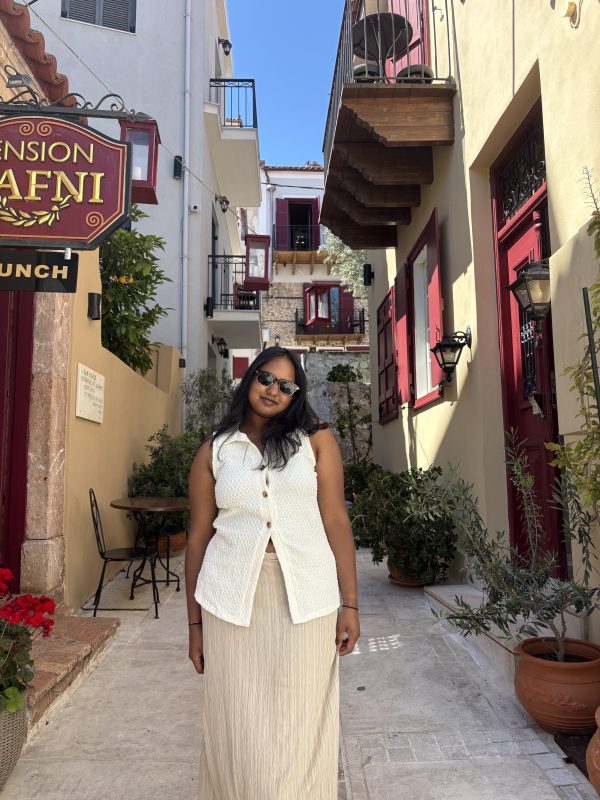
By Rohitha Sanka, who studied abroad on the Athens, Greece: What Is The Life Worth Living? program in Summer 2025.

Why did you choose the location you studied abroad in?
I chose the location I studied abroad in because I knew it was tourist spot but Athens is also known for its historic culture. I believed it was also the perfect first city to explore as it was my first time in Europe. I was aware of the beautiful aesthetics I would see but I also wanted to learn how those became culture and apart of everyday life.
Describe the city you studied in.
The city I mainly studied was in Athens and to describe it would make me speechless. Because we went during May, the weather was perfect; it wasn’t too hot and there was a nice and warm breeze. You could tell there was ancient architecture integrated into the more recent buildings; and urbanization was developed around the monuments and historical landmarks. The size of the city was average, if I could compare the city to one in the US, I would find similar to Chicago. Athens is a very clean city and I would say the aesthetics added to the luxury of the environment.
Day-to-day Transportation
Most of the city was walkable so by the end of the trip my fellow classmates and I preferred that mode of transportation. We also explored the city metro and got a learn a cool fact that most of it was sponsored from some money from the Olympics when they were hosted in Athens. The city metro was very simple to utilize, I think many citizens that use them have it on their phones, reason why the cards we had were paper so it’s easy to misplace. They had a cab service in the bigger parts of town as an option and I’m sure if I were to use the app, Ubers and Lyfts were accessible.
Personal Travel
Due to the duration of the trip, we didn’t really have too much time to self-explore but we did have a lot of time to explore as a group. Some of the things the group had did was travel to a hiking area where we got to see an overview of Athens as a whole. Our mode of transportation was mostly walking, we wanted to make most of it because everything was so accessible. The general cost was fairly low, mostly under 10 Euros, split amongst a group of 5-7. While we traveled to Napflio, we stayed at a European style house, but the entire house was a hotel, which was a nice change from your usual house and Airbnb style.

Food
The foods were various and had a lot of tastes and different backgrounds. Coming into this trip I had to be cautious of the food I ate because of a dietary restriction. With not eating pork or beef I opted for chicken or falafel based foods. There was a section we heavily explored called Plaka and in some of the restaurants had a traditional Souvlaki. I’d say it was a common food we had tried and became a classic. At some of the more sit down restaurants, we tried fried feta called Saganaki. We tried it at a restaurant near the Acropolis and they had drizzled honey on the dish. It was an absolute favorite of mine. I would have to say I wasn’t a really big fan of the Spanakopita, but it’s a personal preference as I don’t like pastry. Some of the sweet treats were fresh Greek yogurt with honey and due to the heat we would eat it as a coolant and as an energizer. The best part about it was it was always fresh!
Language
We were in Athens and traveled more to the south of Greece. Majority of business owners or anyone native we communicated with were English speakers so language barrier wasn’t a huge issue. This bigger culture difference did come with food and travel in general. The signs to businesses were in Greek and as I had taken statistics classes before some of the words were familiar.
Differences in Culture
I found many differences between the U.S culture and the host countries culture. Somethings I struggled with was a water difference. A lot of their water was tap so I struggled to adjust to it the first 3 days. Somethings I did appreciate was the ability to always have fresh food wherever we go and also the idea of being in a walkable city was very health benefiting. I would also say a culture difference was tipping culture; it wasn’t required or expected but wasn’t denied if it was given. This truly let me enjoy the experience!
Locals
The locals were very sweet and prideful of their culture. One of the days we went to a cooking class and we learned to make some of the food we were eating at the restaurants and learn the ingredients and the significance to the culture. Some of the locals wanted to get to know our purpose of the trip and would explain their culture and stories of mythology while we were there. One local even helped me learn some new phrases in Greek for convenience.
Events, Festivals & Holidays
There weren’t any cultural events or festivals because our trip was 10 days but if there were any, I’m sure we would’ve heard from our university guides!
Culture Shock
Again, the biggest culture shock would be just the ability to walk everywhere and since its quite different here, I would advise to bring shoes you have broken into and that are comfortable, because you can’t deny a hilly area.

What type of housing did you live in?
Due to the duration of the trip we mainly stayed in hotels and a European style house in Napflio, we preselected our roommates amongst the group.
Where was your housing located?
The hotel was pretty close to the main city attractions, Plaka, a neighborhood that had tourist spots, restaurants, shops surrounding historical sites. We were about a 5-10 minute walk from the neighborhood so we would go there often during our downtime.

Academic Environment
Our lectures were onsite a historical site, so it was very application based. Considering a lot of the times material is usually taught in the classroom this was a different academic environment because we could physically imagine we were there as we learnt the history of a place.
What was the cost of living abroad?
I would say everyday costs were very fair and survivable. A lot of the lifestyle was extremely flexible and expenses weren’t a huge worry for anyone. I stayed very much into my budget and there were some student discounts were offered at the Acropolis and its museum.
Communication
While I was abroad, we mainly used WhatsApp because it’s a common international communication app. I have T mobile so my data plan is covered internationally.
Packing
When it comes to packing, it really depends on the time you are going but if its summer time, I wouldn’t hesitate to pack some workout clothes. You always want Instagram worthy clothes! But comfort also matters, the place you go might be a flat terrain or a steep one but its always good to have backup.

Why did you decide to study abroad?
I decided to study abroad because I knew having a culturally immersive experience would have a positive impact on me and the way I view the world. After coming back my perspective on how to handle situations changed because I was able to meet and engage with people in different areas of the world. Seeing how people live different lives and have similar priorities showed me how big the world is and that experiences are meant to happening.
What part of your experience made the greatest impact on you?
The best part of the trip was when we were hiking up to the Acropolis, it began pouring and we had to stop halfway and find shelter. As we felt like it was ok to start hiking up again, the sun starting shine and quite cinematically, the clouds started spreading to make way for the sunshine. As the sun began to reflect on the marble it was just a beautiful sight to see and a reminder of how the metaphor “storm before the calm” was happening literally and it was a reminder to take things as they come in life.
In your opinion, why should students study abroad?
I think students should study abroad because it’s a reminder of identity and pride. It reminds yourself a sense of belonging because you are asked “Where are you from”. You begin describing yourself and your background. When people do that self reflection, it’s a reminder that everyone has a story and there’s always a reason to be kind.