Italy versus Turkey: Designing Sacred Narratives
By Enoch Adedeji, who studied abroad in Rome, Italy, and Istanbul, Turkey, Spring 2025
Italy and Turkey, or more specifically Rome and Istanbul, are cities within countries that possess a deep
religious history. Architecture is intimately tied to this history, and is often responsible for telling its multiple
stories. In observing the architecture of the religious typology (churches and mosques), distinct modes
of storytelling come to the fore; through the design of form, image, and language, art and architecture
accompany the adventures of sacred narratives.
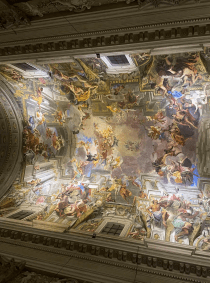
Roman churches are often filled with images of religious figures and representations of God or
nature. Carved into stone or painted onto high ceilings, grandiose stories of heaven and Jesus layered
onto an indelibly grand building are meant to capture the eye of the believer upon entry. In contrast,
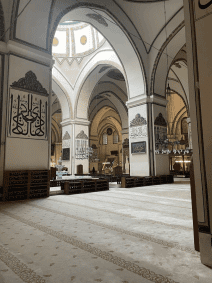
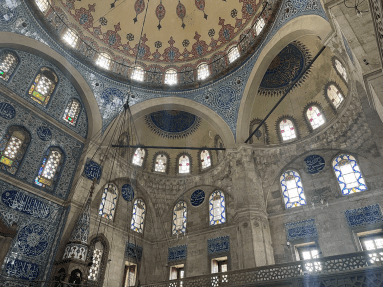
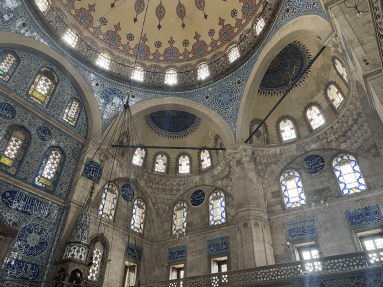
the mosques of Istanbul lean toward a formal abstraction layered upon innovative structural ideas to
produce an almost otherworldly geometric landscape amidst the tall walls and domed ceilings. The
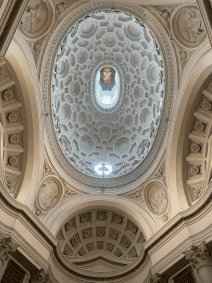
orders of the capital seen throughout Rome and Roman architecture should be viewed in relation to the
muqarnas capitals of the Islamic world, and the images of religious figures should be viewed in relation
to the abstract landscape of geometric forms and Arabic lettering. Both religions, and whatever blurry
line we might draw to distinguish them, rely on and manipulate architecture to tell stories of God and
scripture, capturing the occupant in a world of sacred exuberance.